
READING John 1 v 6 -8 and 19 -28
There was a man sent from God whose name was John. He came as a witness to testify concerning that light, so that through him all might believe. He himself was not the light; he came only as a witness to the light.
John the Baptist Denies Being the Messiah
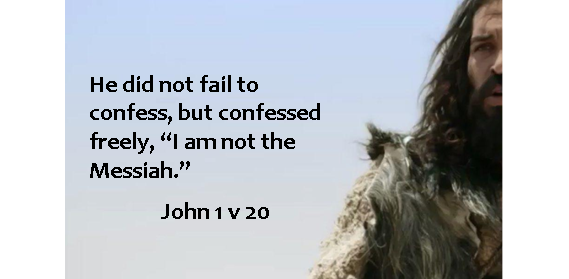
Now this was John’s testimony when the Jewish leaders in Jerusalem sent priests and Levites to ask him who he was. He did not fail to confess, but confessed freely, “I am not the Messiah.” They asked him, “Then who are you? Are you Elijah?” He said, “I am not.” “Are you the Prophet?” He answered, “No.” Finally they said, “Who are you? Give us an answer to take back to those who sent us. What do you say about yourself?” John replied in the words of Isaiah the prophet, “I am the voice of one calling in the wilderness, ‘Make straight the way for the Lord.’”
Now the Pharisees who had been sent questioned him, “Why then do you baptize if you are not the Messiah, nor Elijah, nor the Prophet?” “I baptise with water,” John replied, “but among you stands one you do not know. He is the one who comes after me, the straps of whose sandals I am not worthy to untie.” This all happened at Bethany on the other side of the Jordan, where John was baptizing.
SERMON
Helen Keller an American author who was deaf and blind tells of the dramatic moment when Anne Sullivan her lifelong friend and instructor first broke through her dark, silent world with the illumination of language:
“We walked down the path to the well house, attracted by the fragrance of the honeysuckle with which it was covered.
Someone was drawing water and my teacher (Anne) placed my hand under the spout. As the cool stream gushed over one hand she spelled into the other hand the word water, first slowly, then rapidly.
I stood still, my whole attention fixed upon the motion of her fingers. Suddenly I felt a misty consciousness as of something forgotten, a thrill of returning thought; and somehow the mystery of language was revealed to me.
I knew then that “w-a-t-e-r” meant that wonderful cool something that was flowing over my hand. That living word awakened my soul, gave it light, hope, joy, set it free!”
The moment that Helen Keller describes is that moment her world of darkness was shattered with the light of language. Although she was the same person physically, her life was transformed. She now had a way she could see and understand.
Spiritually speaking, people today seem to be living in a world of darkness.
Some of you may recognise the words to the Simon and Garfunkel song from the 70’s entitled The Sound of Silence: “Hello darkness, my old friend, I’ve come to talk with you again.”
Nothing has changed that much from the 70’s. People are living in spiritual darkness and they need divine illumination. So often they don’t realize it for as Helen Keller said, she only realised she was living in darkness when she saw the light of human language
So it is with us. We often only realise our darkness when we see the light of Christ.
We are once again in Advent, a time as Bishop Stephen Conway, once said “it is our special pleasure to wait for the coming of the past. During Advent we rehearse our salvation history by particular reflection upon the revelation of God in the Old Testament and the promise of prophecy that the Messiah will come”
The ministry of John the Baptist, the star of our Gospel reading today, was prophesied in the last chapter of the Old Testament – Malachi 4:5 and 6
“See, I will send the prophet Elijah to you before that great and dreadful day of the LORD comes. He will turn the hearts of the parents to their children, and the hearts of the children to their parents; or else I will come and strike the land with total destruction.”
And with that the Old Testament ends and the voice of prophecy is silent for 300 years.
Three of the four Gospels begin with the life and ministry of John the Baptist – the forerunner of Jesus Christ the Messiah and you might be forgiven in asking why does John the Baptist figure so prominently?
Well one reason is that John’s life and ministry was prophesied in the last book of the Old Testament, the book of Malachi, “See, I will send my messenger, who will prepare the way before me. Then suddenly the Lord you are seeking will come to his temple; the messenger of the covenant, whom you desire, will come,” says the LORD Almighty. (Mal 3:1)
Hence John is able to fulfill the prophecy that the message and ministry of Jesus Christ (including his death and resurrection) is the fulfilment of the Old Testament.
Secondly John was the messenger. Why did God have to send a messenger ahead of His Son Jesus you may ask? The only reasonable answer I can come up with is that in those days, kings were preceded by a messenger announcing their arrival to the local population.
The messenger would go ahead and let people know the king was coming, so people could repair their part of the local road on which the king would travel and be ready to welcome him.
John wasn’t there by chance or being the right man at the right time. No, John was there because God had CALLED John to be the messenger who went ahead of Jesus.
So you might wonder why, when John is calling people to repentance was the Jewish leaders were so concerned who John the Baptist was. Were they missing the point?
I don’t think so, but to understand why we need to consider the political climate of the time.
Judea was a hotbed of unrest. It was a province of deep unrest in the Roman Empire
The Jews constantly harked back to the golden days of Judas Maccabeus who in 167 BC had led a successful revolt against Antiochus IV the King of Syria who had invaded the country and taken Jerusalem.
And to add insult to injury of invasion, Antiochus had sacrificed a pig on the main altar in the Temple in Jerusalem, an ultimate insult to the Jews! It was this act that provoked the Jews and they rose up under Judas Maccabees leadership and threw Antiochus out.
The kingdom of Israel, which followed was quite successful for about 100 years and quite prosperous too. Then, in 63 BC Pompey, the Roman general was asked to decide between two claimants to the throne of Israel.
But instead of choosing one, he decided to invade and annexed Judea to the Roman Empire.
In addition to this we need to understand that at the time of John the Baptist there were four main parties of Jews.
The first and most important party was the Pharisees, the main religious orthodox party. People we find in Scripture such as Nicodemus and Gamaliel as well as Paul the apostle would have been Pharisees.
Then there is the Sadducees who represented the ruling class. Caiaphas and Annas the High Priest at the time of Jesus execution would have been Sadducees.
We come across the Pharisees and Sadducees quite a bit in the Gospels.
The third party the Zealots was a terrorist organization dedicated to throwing the Romans out by force. Two of Jesus’s original 12 disciples where Zealots. Judas Iscariot and Simon the Zealot.
The last group was the Essences, who had decided to opt out of society and founded their own communes the most famous of which was Qumran where the Dead Sea Scrolls were found.
So at the time of John the Baptist, so called messiahs sprung up quite regularly across the country all offering to rid the country of the Romans by force and these so called messiahs often attracted a following. So it was quite natural for the Jewish leaders to ask if John saw himself as one of these messiahs.
But John was adamant he wasn’t so the question still remained who was John?
By his own admission John was simply the forerunner of the Messiah whose “sandals I am not worthy to untie”. (Jn 1:27)
So you see John was countercultural. He pointed away from his ministry because he recognised that Jesus’ ministry to be more important.
Even in the midst of spiritual revival when people were repenting of their sins and being baptised the temptation would have existed to say “I am somebody great”.
But John realised that his ministry was not to point to himself but to Jesus
So just like John the Baptist, we Christians are called to point past ourselves and point people to Jesus and that I offer to you that this the message of John the Baptist in today’s lesson.
It is easy to get caught up in the culture of consumerism at Christmas which feed the unholy Trinity of I, myself and me.
I find it amazing that people are crying out this year especially during this time of Covid that we should have Christmas and the government is saying yes feed the economy but be careful. People are crying out “We need Christmas” but my question is but what Christmas are you wanting?
Is this not a time above all times when we can actually see Christmas for what Christmas is? A time for seeing “Christ” in Christmas? and not just the big social gatherings and present buying.
We don’t need to go to the shops or even order on line to purchase a present because the “greatest Christmas present“ we can give people is to introduce them to Jesus.
To show the light of Christ in the darkness.
We need to point them past ourselves as John did when he said I am not the “Big Cheese”, but Jesus is.
I wonder how the Church would be transformed if we, as Christians changed our way of thinking and professed to saying “I am not worthy to untie his sandals.”
In the absolute, no one is in the same class as Jesus who was sinless. But the amazing thing about God is THAT DOESN’T MATTER because what does matter is what John records in John 1:12 “Yet to all who received Jesus, to those who believed in his Name, he gave the right to become Children of God”.
We did not earn the right to become children of God. We simply received this as a present from God.
What a Christmas present to know that we have become a child of God through faith in Christ.
Now, that is Good News to share with others. That’s a Christmas present worth giving to others are you prepared to give it? Amen.
PRAYERS
Let us pray to God, the source of all light and life.
Send your spirit upon the Church, for the declaration of the Gospel to all nations. Give to your people the prophetic voice that brings knowledge of salvation through Jesus Christ.
Lord in your mercy, hear our prayer
Restore to new life the places that human folly have made desolate. Guide into the true light those who work with anger and destruction towards others. Lead all nations to be one in the name of Christ.
Lord in your mercy, hear our prayer
Make us your messengers among our friends and neighbours, and all with whom we share our lives. Bless to a rich harvest all the signs of hope and growth within our community.
Lord in your mercy, hear our prayer
Bring freedom to those who are unjustly in captivity and those who are imprisoned in their own despair. Comfort and raise up to new life those whose hearts are broken by sorrow.
Lord in your mercy, hear our prayer
We give thanks for all who have heard the message of salvation and passed from this world into the full knowledge of Christ. Keep us constant in faith until we too shall come to see him.
Lord in your mercy, hear our prayer
We pray confident in the grace of baptism and led by the light of Christ.
Merciful Father, accept these prayers for the sake of your Son, our Saviour Jesus Christ. Amen
And so we seal our prayers in the prayer that Jesus taught his disciples
Our Father, who art in heaven, Hallowed be thy name,
Thy kingdom come, Thy will be done; on earth as it is in heaven.
Give us this day our daily bread and forgive us our trespasses,
as we forgive those who trespass against us.
And lead us not into temptation but deliver us from evil.
For thine is the kingdom, the power and the glory,
For ever and ever. Amen
Revd Kevin. Priest at St.Wilfrid and St.Thomas
