
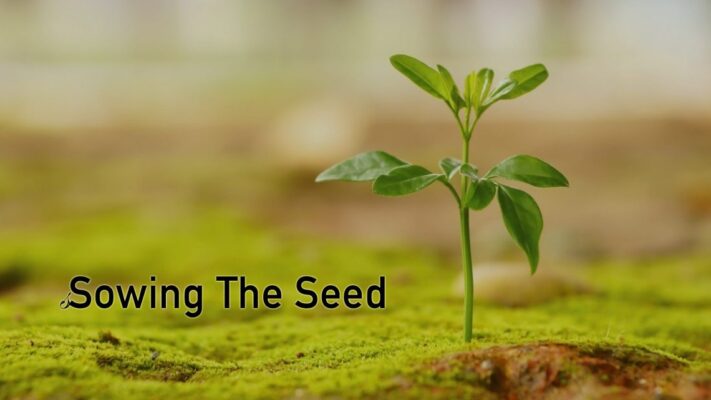
READING: Mark Chapter 4 v 26 – 34
He also said, “This is what the kingdom of God is like. A man scatters seed on the ground. Night and day, whether he sleeps or gets up, the seed sprouts and grows, though he does not know how. All by itself the soil produces grain—first the stalk, then the head, then the full kernel in the head. As soon as the grain is ripe, he puts the sickle to it, because the harvest has come.”
Again he said, “What shall we say the kingdom of God is like, or what parable shall we use to describe it? It is like a mustard seed, which is the smallest of all seeds on earth. Yet when planted, it grows and becomes the largest of all garden plants, with such big branches that the birds can perch in its shade.”
With many similar parables Jesus spoke the word to them, as much as they could understand. He did not say anything to them without using a parable. But when he was alone with his own disciples, he explained everything.
SERMON
When Jesus started to face opposition from groups like the Pharisees and Scribes, He started to address the crowds in parables. Now the purpose of the parable is twofold. On one hand, it is easy to understand the story as it comes from real life. Jesus used parables using farmers, fishermen, investors, and other professions to compare them to a spiritual truth He wanted to make. But on the other hand, the purpose of the parable was to hide the truth from those who were not given the key to understanding the parable.
In the parable found within today’s passage from Mark, it is easy to understand what the sower is doing, and that plants grow on their own without intervention and without the farmer knowing why the seed becomes a plant. I would suppose today with our scientific understanding, it is not as much a mystery as it once was. But obviously Jesus was interested in saying something more than to observe how they grow.
Part of the key to understanding a parable is to carefully read it and offer up two questions to a parable. One question is: “What does it say?” and the other question is: “What does it NOT say.” So let us use these two questions to investigate today’s parable.
First of all it says that this parable describes a truth about the kingdom of God. It is like a man who threw the seed upon the ground. It does not identify what kind of person threw the seed. That detail is not important to the parable. Therefore this tells us the parable is not about a man or a woman who threw the seed. It could be any man or any woman.
It then says that this sower went on with life night and day. It does not say that he/she cultivated the field, ploughed it, watered it, weeded it, or anything else other than days passed. This means that what the person did other than scatter the seed is unimportant to understanding the parable. In fact, this person seems to be somewhat ignorant of the process. They could see what was happening. The plants came up and went to the maturing process by themselves without mentioning any intervention on the man’s part. The Greek word about what happened is the same as our word “automatically.” It is something in the seed and the hand of God that makes it happen. It is in the DNA.
When the harvest is ripe, the person is fast to take the sickle to the grain to harvest it. The recognizing the proper time to harvest and then making haste to harvest it before the birds and insects ate up the ripe grain is an important detail to the parable.
Jesus then speaks a second parable about a mustard seed. Here, the detail to be observed is the tiny size of the seed. Jesus may even have plucked the seed from off the tree to show just how tiny it was. The other detail is the size of the mustard tree. It grew large enough for birds to roost in it. These are the only two important details. In is unnecessary for understanding to include detail like the use of mustard as a spice or some other details. If one were using a slogan it would be: “Great things start from humble beginnings.”
Now we have to realize that Jesus is not giving practical advice. What do these two parables say about the Kingdom of God? Let us look at the first parable. We are called to sow the seed of the kingdom. However, there is certain humility to this. The gospel is not about us. It is our job simply to scatter the seed faithfully. We like to think that we have to control the process of evangelism. We come up with schemes to sow the seed. We try to prepare the ground, weed, cultivate, etc. We want to control the process. What we have to realize is that it is the gospel itself which causes growth. It’s not what we do but what the Gospel does. God has put the DNA in the message. It comes up of itself, and not by our effort. We don’t even have to understand why it works. We simply get to see it grow.
This does not mean however that we simply sit back and watch. We are called to nurture the seed. We are to teach them whatsoever things Jesus has commanded. What we do have to do is to do it God’s way and not our own. We must feed them the gospel itself, to tell them what Jesus began to do and to teach.
The second parable is prophetic of the growth of the church. The church began with a tiny group of disciples who followed Jesus, Days and nights passed, yet at the Day of Pentecost, the church had only 120 members which is practically nothing compared to the 100 million inhabitants of just the Roman Empire. Then there were 3000, then 5000, which is still not numerically significant. But within 300 years, it conquered the Roman Empire.
The seed is tiny but powerful. In the beginning, God speaks a little word and the entire cosmos comes into being. Jesus speaks a little word and the blind see and the deaf hear. Jesus speaks a word and the dead man comes to life. It is not the size but the power that resides in the seed.
So here we are 2000 plus years later. Some think that the seed has lost its power. The church seems to be declining in influence. The era is called “Post-Christian.” Is this true? Of course not! The seed of the gospel is just as lively as ever. It just needs to be scattered once more. We need to scatter the pure Gospel. The trouble is we have tried to genetically modify its DNA, thinking we know better than God who made the seed in the first place. Instead of increasing the yield, a weaker plant comes up. It might look large and healthy perhaps, but the purpose of the plant is to produce fruit. We have to stop trying to monkey with the gospel and simply to proclaim it.
It is not dependent upon the character of the preacher either. Any preacher who preaches the truth of the Gospel will do. The personality is not important. One of the well known evangelists in our time, Billy Graham indeed scattered much seed in his day, and it resulted in a large harvest of souls. But those who became Christians under his ministry did not become Christians because Billy Graham spoke it. Rather it is because God used the preaching of Billy Graham. It is the word of the Gospel which Billy Graham which brought those who were dead in trespasses and sins to life. Billy Graham has gone to his reward now, but if he were here, I believe he would agree with this statement.
The one who sows the seed does not know how the seed grows and produces a large crop. He just knows that it does. Sometime the yield varies as we see in the parable of the sower. I do not know what Billy Graham has had the success he has had in ministry and I have not. But I do rejoice that people have been born into the Kingdom of God, by whose hand does not matter. We just need to keep throwing the seed and casting the dragnet.
Finally, we have to know when the harvest is ripe. We need to be able to see that the time to reap has come. This must be done by God’s help. The sickle is sharp. There is pain involved, but after the seed has matured, the time comes to harvest the wheat. It might take time for the word to come to maturity in the people we witness to. Days and nights might pass, but the day comes in which the person is ready to make a commitment to follow Jesus. Harvest too soon and the fruit will be immature and die. Harvest too late and the seed might be carried away by Satan.
Sow the pure seed of the Gospel. Be patient and trust God to make the seed grow. Then be ready to harvest. Do this enough times and the Kingdom of Heaven will grow great and God will be glorified.
PRAYERS
Jesus several times used the image of seeds to illustrate his teaching that small things have great potential, including small seeds of faith. Imagine, then, that in this time of intercession you are planting seeds of prayer in the Garden of God’s love laid out before you…
First of all, plant seeds for your family and close friends. These are the ones you care deeply about, knowing them wee, with all their beauty and sharp edges. You know their needs today, and their challenges. .And you have such hopes for them. Plant those seeds of prayer for them now, and trust God to bring about the growth.
(Pause)
Now plant some seeds of prayer for people you know less well but who are part of the tapestry of your life. They may be people you work with or know through a charity or a community group. They may be neighbours with whom you exchange cheerful greetings but not much more. Or perhaps people you see regularly at the shops, school gate or some other setting. Plant seeds of prayer for these people whom you don’t usually pray for, but whom God lays on your heart…
(Pause)
Now plant some seeds of prayer for people who are in the public eye, for good or ill. People in the news, political leaders under constant pressure especially those attending the G7 meeting. Pray for sportsmen and women with great expectations laid on them, celebrities with huge temptations to believe their own publicity. Who catches your eye? Who might be in particular need of support and wisdom at present? Plant seeds of prayer for some of those people now…
(Pause)
Further away in the garden of God’s love, seeds of prayer are needed for places and nations collapsing under the pressures of war, famine, natural disaster, bad governments and the ravages of the Covid pandemic. Take a handful of seeds and plant them well, for this is where seeds get trampled on and birds eat them up. Plant those seeds deep and water them well, and be prepared to return often to care for the fragile early growth…
(Pause)
You have seeds left over. Cast them wide over the whole garden, for we have a world deeply in need of payer at all points and all times. Cast those seeds with love and joy, for this is our privilege, to work with God to sustain and heal the world in anticipation of a new creation, a new Eden…
(Pause)
You have one seed left. At your feet is a special patch of soil where you can plant a seed of prayer for yourself. What does your heart seek? What do you most need? Where do you feel vulnerable? Plant that seed tenderly now…
(Pause)
Jesus said “If you have faith the size of a mustard seed you will say to this mountain, “Move from here to there”, and it will move, May it be so with these prayers, Lord, which we offer in Jesus name.
Merciful Father, accept these prayers for the sake of your Son, our saviour Jesus Christ. Amen
And so we bind our prayers together in the words that Jesus taught his disciples
Our Father, who art in heaven, Hallowed be thy name,
Thy kingdom come, Thy will be done; on earth as it is in heaven.
Give us this day our daily bread and forgive us our trespasses,
as we forgive those who trespass against us.
And lead us not into temptation but deliver us from evil.
For thine is the kingdom, the power and the glory,
For ever and ever.
Amen
Revd Kevin. Priest at St.Wilfrid and St.Thomas
