
READING: Luke Chapter 10 v 23 – 37
Then he turned to his disciples and said privately, “Blessed are the eyes that see what you see. For I tell you that many prophets and kings wanted to see what you see but did not see it, and to hear what you hear but did not hear it.”
On one occasion an expert in the law stood up to test Jesus. “Teacher,” he asked, “what must I do to inherit eternal life?” “What is written in the Law?” he replied. “How do you read it?” He answered, “‘Love the Lord your God with all your heart and with all your soul and with all your strength and with all your mind’ and, ‘Love your neighbour as yourself.’ “You have answered correctly,” Jesus replied. “Do this and you will live.” But he wanted to justify himself, so he asked Jesus,
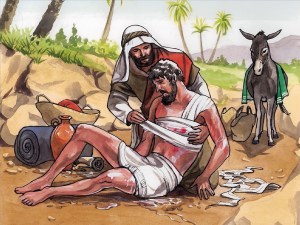
“And who is my neighbour?” In reply Jesus said: “A man was going down from Jerusalem to Jericho, when he was attacked by robbers. They stripped him of his clothes, beat him and went away, leaving him half dead. A priest happened to be going down the same road, and when he saw the man, he passed by on the other side. So too, a Levite, when he came to the place and saw him, passed by on the other side. But a Samaritan, as he travelled, came where the man was; and when he saw him, he took pity on him. He went to him and bandaged his wounds, pouring on oil and wine. Then he put the man on his own donkey, brought him to an inn and took care of him. The next day he took out two denarii and gave them to the innkeeper. ‘Look after him,’ he said, ‘and when I return, I will reimburse you for any extra expense you may have.’ “Which of these three do you think was a neighbour to the man who fell into the hands of robbers?” The expert in the law replied, “The one who had mercy on him.” Jesus told him, “Go and do likewise.”
SERMON:
The parable of the Good Samaritan is one of the best-known parables of Jesus. But like all parables, they serve as illustrations. They shed light on a topic and flesh it out. So, when we interpret this parable, we must first find out why Jesus uses this parable. What is Jesus trying to shed light on? At first it might seem that it is to answer the religious lawyer’s question: “Who is my neighbour?” whereas there is truth in this statement, there is more to the parable to this than simply to answer this question.
To find out why Jesus used this parable, we must look to the entire exchange between Jesus and the lawyer.
When we start at verse 25, we see that the lawyer initiated the dialog. He asks Jesus what good work he should do to inherit eternal life. It also says he asked Jesus to test Him. This was an unusual question to ask as many Jews thought that they inherited eternal life just because they were Jews and that God had promised eternal life to them. It is true that some thought eternal life could be lost by apostasy from Jerusalem. But the view was that eternal life was something not to be lost rather than something to be gained.
In a typical Rabbi fashion, Jesus answered the man’s question with a question.
He asked the lawyer how he understood the Scripture. The man responded with the well-known combination of the Jewish “Shema” which commanded the Israelite to complete loving commitment to Yahweh. “You shall love the LORD your God with all your heart, soul, strength and mind.”
Every Jew was expected to memorise this. But the man adds to this a quote from Leviticus 19: “You shall love your neighbour as yourself.” This too was known by the Jews. Jesus Himself had put these commandments together (Matthew 22:40).
These two were the great commandments upon which the Law and the Prophets hung. Jesus commends the man for having given the correct answer. He adds: “Do this and you shall live.” Jesus’ words sank deep into this man’s heart. They shined upon a defect in the man’s character. The defect did not seem to centre upon his devotion to Yahweh, although he should have seen the problem here as this comes first. Instead, he was bothered by the second commandment about love for neighbour which is truly the demonstration of our love for the LORD.
So, the men that asks: “Who is my neighbour?” For many Jews, the neighbour was not the person who lived the closest to him or her. It was the closest JEWISH neighbour. Perhaps this man was troubled by this interpretation. Perhaps God had pricked his heart that this was an unsatisfactory response to the second great commandment. The Law of Moses commanded that the strangers who lived within Israel were to be equally treated under the Law. “There shall be one law for you and for the stranger (Exodus 12:49; Leviticus 24:22; Numbers 15:16 et al). As this man was a scholar of the Scripture, he was aware of these verses.
So, Jesus answers this question with a parable and he starts it in the conventional way. People knew the dangers of the Jericho road. It was narrow and tortured. There were cliffs with caves where robbers would hide on one side and a sheer drop into a canyon on the other. The road was unsafe for the solitary traveller. The robbers would swoop down on the victim in a violent attack and rob him. Usually the victim would be thrown off the cliff afterward as leaving him bloody on the road would warn others of the presence of these highwaymen. But in this case, the half-dead body of the man was left lying on the road.
Jesus goes on by noting that a priest happened to be going down the road. The LORD had called the priests to intercede for the people and their troubles. But the priest was also not to touch a dead body as well (Leviticus 21). The priest also realized that there were robbers in the area. To be off guard by stooping down to check the man put his own life at risk. It is also interesting to note that he was going DOWN the road rather than up the road. The priest was headed toward Jericho and not Jerusalem.
There is a metaphor here that people today are likely to miss. One always ascended to Jerusalem regardless of the elevation of the place from which they came. There is a moral component to this. He was morally descending as well as physically descending. The priest who was to be totally dedicated to the service of Yahweh was headed in the wrong direction, even though he could reason from Scripture that he was avoiding contact with a dead body even though the man was not yet dead.
The hearers of this parable probably justified the priest’s action because of this.
So the priest passed by on the other side. Perhaps he kept his head up so as not to look at his need for compassion. If he passed by on the side of the road next to the sheer drop, his lack of looking where he was going could have made his descent quite fast.
Jesus reinforces his parable by having a Levite pass by next. Even though Levites were dedicated to the service of Yahweh like the priest, there was no prohibition to touching a dead body other than they would be unclean for seven days. So the Levite didn’t have the excuse that priest had. Nevertheless, he does the same thing as the priest and passes by.
The parable now turns from the conventional to the shocking. The next person on the scene was a Samaritan. Although the Samaritan people had some Israelite blood, they were of mixed race. The Jews in Nehemiah’s time refused to let the Samaritans help in rebuilding the walls of Jerusalem. The priests and Levites were ordered to divorce their foreign wives and dismiss the children of that marriage. The Jews had burnt down the Samaritan temple on Mount Gerizim as well. The Samaritan could not have been more different than either the pure-blooded priest or Levite.
The Samaritan saw the man and his need. We know nothing of the racial identity of the man who was robbed. But if he were a Jew, it would have made this parable even more outrageous. But Jesus does not identify this man as a Jew. It would actually go against the interpretation of the parable if he did.
It really does not matter who the person’s ethnic identity was. The necessary identity of this person was than he was in desperate need of medical attention or he would die.
Whether a stranger or a member of the Covenant, the law of compassion equally applied. The Samaritan believed in the first five books of the Scripture, the Torah. He actually applied the Scripture he knew. It is true that he did not hold to the Prophets and that there were some serious theological defects in the Samaritan religion. Yet for all the Samaritan man’s faults, he was actually closer to the truth than the more orthodox Jews. The lawyer had already realized the great commandments of the Law upon which the rest of the Law was to be interpreted. Every other law or precept was to be interpreted in light of these great commandments. The Samaritan was actually putting these commandments into practice.
The rest of the story is familiar to most. The Samaritan pours oil and wine into the wounds and bandaged the wounds. He put himself at great risk as a merchant would be choice prey for the robbers. But his need to care for the man was greater than the danger he faced. He put the man on his donkey and brought him to an inn. He left money with the innkeeper to care for this poor man and promised to repay him if the expenses exceeded the denarius he had given the innkeeper. He then resumed the journey he was on. When he completed the business trip, he would check back in.
What an example of care! No wonder the example set by the man has become the metaphor for Good Samaritan ministries. Jesus had made this parable most lifelike.
We, or course must realise that this is a parable. The particular Good Samaritan might not have lived. But he lives whenever people risk danger and overcome prejudices to care for people in need.
Jesus finishes the parable and asks the lawyer one more question: “Which of these three was the neighbour to the man who fell among thieves?” There is always power in getting someone else to answer their own question. Through the parable, the lawyer became able to answer his question to Jesus on who his neighbour was. He answered: “The one who showed mercy.” Jesus responds by saying: “Go and do likewise.”
So, the parable goes beyond just answering a question of who one’s neighbour was, even though it does include this. It shines out the proper understanding and application of the Law. The Law’s primary purpose is to demonstrate the mercy and love of God to humanity as well as a command to model this love and mercy to others. The Good Samaritan stands as an example which shows us how this principle of love and mercy should be acted out.
Even the Ten Commandments begin with the words: “I AM Yahweh your God which brought you out of Egypt, out of the house of bondage” (Exodus 20:1). These are words of love and mercy. Israel was crying out half-dead in Egyptian bondage. God showed them mercy and delivered them out of Egypt. He fed them and gave them drink on the way. He led them into a promised land.
Likewise, Jesus disregarded the dangers of death and was wounded and killed in our behalf. This was an act of sheer mercy and love. Jesus proved His love for the Father by demonstrating this love upon helpless humanity which was dead in trespasses and sin. He died for us. But He also arose, healed and healing.
Likewise we are therefore challenged to demonstrate God’s love and mercy by showing the same to others. They do not deserve mercy any more than we did. But nevertheless, God expects us to be like Him, to follow the example of the Son whom He sent. We must move beyond the prejudices we have and show mercy. We don’t deserve eternal life of course, yet we have been graced with eternal life.
Eternal life does have its proper understanding in a never-ending life with Jesus, but it is also a quality of life which we are to live and demonstrate in the here-and-now. Even though our works do not save us. We do nothing to inherit anything. BUT if we are saved by God’s grace, we are transformed by that grace. “We love him because He first loved us.” By God’s grace we are transformed to be gracious. By being loved by God wholly, we can Love Him wholly in return. And the proof of this love is demonstrated to our neighbour. Amen
PRAYERS:
Father, help us remember that Jesus is the one who has set us free from the law of sin and death, that in his love he forgives us completely for all that we have done wrong and calls us to live by the law of the spirit of life, a law which when written upon hearts of faith makes all of human life a joy and a blessing.
Lord in your mercy, hear our prayer.
Gracious God, we thank you for drawing us together once again as one family today, a family that reaches around the world. We thank you Father for your gracious love, for your wonderful mercy, and for your living word Jesus Christ our Saviour.
Help us this day, O Lord, to live by faith in him and to love one another in the way that he love us…. help us keep jealousy and envy out of our hearts, help us keep pride and selfishness out of our conversations, and desire and greed out of our relationships.
Lord in your mercy hear our prayer.
Watch this day over your church around the world O Lord, help us to witness to your love and your grace, to share with those who are less fortunate than we, to support those who work for justice and equity, to assist those who bring hope and health and healing to those in despair.
Lord in your mercy hear our prayer
We hold before you O God, the particular joys and concerns that you have placed upon our hearts today, for those of our family and our church and those beyond…
We remember before you: (Please take this time to offer someone who you may know who is struggling at this time)
Lord in your mercy hear our Prayer…
Merciful Father, accept these prayers for the sake of your Son, our saviour Jesus Christ. Amen
And so we bind our prayers together in the words that Jesus taught his disciples
Our Father, who art in heaven, Hallowed be thy name,
Thy kingdom come, Thy will be done; on earth as it is in heaven.
Give us this day our daily bread and forgive us our trespasses,
as we forgive those who trespass against us.
And lead us not into temptation but deliver us from evil.
For thine is the kingdom, the power and the glory,
For ever and ever.
Amen
Revd Kevin.
Associate Priest at St.Wilfrid and St.Thomas
