
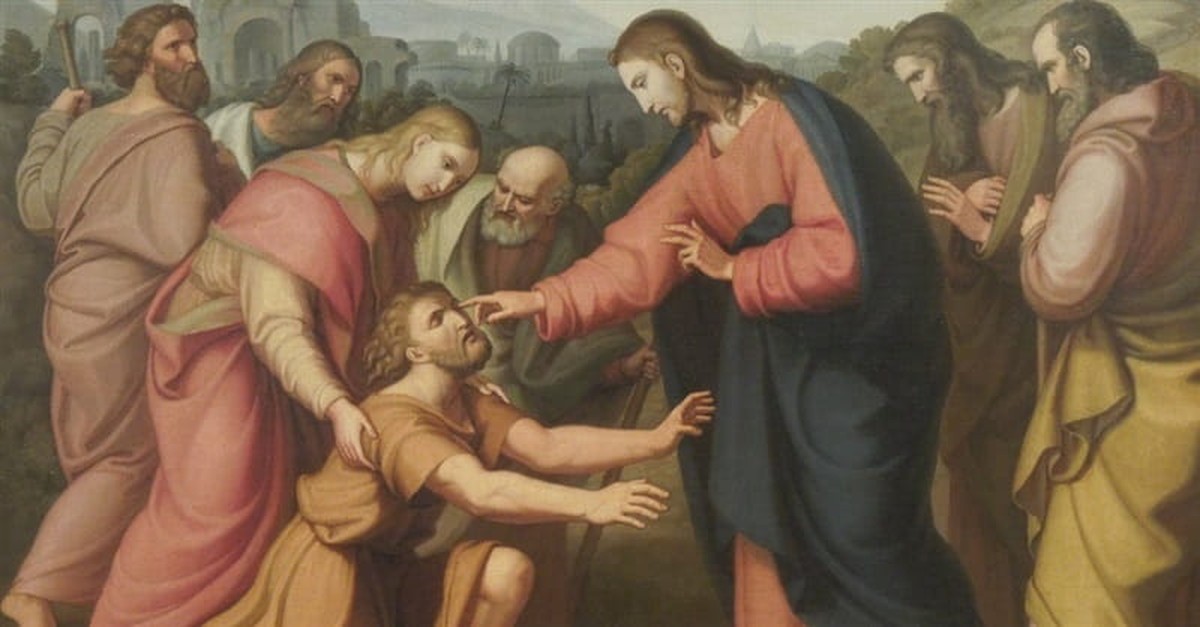
READING: Mark Chapter 10 v 46 – 52
Then they came to Jericho. As Jesus and his disciples, together with a large crowd, were leaving the city, a blind man, Bartimaeus (which means “son of Timaeus”), was sitting by the roadside begging. When he heard that it was Jesus of Nazareth, he began to shout, “Jesus, Son of David, have mercy on me!” Many rebuked him and told him to be quiet, but he shouted all the more, “Son of David, have mercy on me!” Jesus stopped and said, “Call him.” So they called to the blind man, “Cheer up! On your feet! He’s calling you.” Throwing his cloak aside, he jumped to his feet and came to Jesus. “What do you want me to do for you?” Jesus asked him. The blind man said, “Rabbi, I want to see.” “Go,” said Jesus, “your faith has healed you.” Immediately he received his sight and followed Jesus along the road.
SERMON: Today’s Gospel reading is the story of Jesus restoring the sight to the blind man Bartimaeus.
When I undertook my curacy at All Saint’s Annesley there was a lovely elderly lady who was blind. She was a local lady who had worked many hard years in service at the Musters family home in Annesley but in later years she had lost her sight. She was brought to church and joined in with all the services along with other social activities. People would bring her tea and biscuits after the service and she could recognise the voices of the people around her. She was much loved and her death affected a lot of people but can you ever begin to imagine what it must be like to be blind especially when at one time you could see.
Just as Bartimaeus had an effect on those who were following Jesus, the lovely lady at Annesley, another modern day person also had an effect on people she met and worked with. Her name was Helen Keller.
Helen Keller was a blind and deaf author, political activist and lecturer who received critical acclaim for her achievements throughout her career.
She was born on June 27, 1880, in Alabama USA with the ability to see and hear. However at 19 months old, she contracted an illness described by doctors as “an acute congestion of the stomach and the brain”, which might have been scarlet fever or meningitis.
The illness left her both deaf and blind. Keller went on to become a world-famous speaker and author. She is remembered as an advocate for people with disabilities, When Keller was young, she was introduced her Christianity, Keller famously said: “I always knew He was there, but I didn’t know His name!
Her spiritual autobiography, My Religion, was published in 1927 and then in 1994 extensively revised and re-issued under the title Light in My Darkness.
As well as writing, Keller was a member of the Socialist Party and spent years fundraising to improve life for blind and deaf people along with campaigning tirelessly to alleviate the living and working conditions of blind people, who were badly educated and living in poor conditions. Her activism became a major factor in changing life for those with sensory loss.
Keller suffered a series of strokes in 1961 and spent the last years of her life at her home. She died in her sleep on June 1, 1968, at her home,
Helen was inspiring in the way she dealt with her deafness and blindness. She once wrote a magazine article entitled: “Three days to see.”
In that article she outlined what she would like to see – if she were granted just three days of sight. It was a powerful and thought provoking article.
On the first day she said she wanted to see her friends.
The second day she said she would like to be able to look at nature around her.
And on the third day, she said she would like to spend her time – in her home city, New York watching the busy city and the bustle of work. She concluded her article with these words: “I who am blind can give one hint to those who see: Use your eyes as if tomorrow you were stricken blind.’
Blindness in the 21st century is bad enough – but it was much worse in Jesus’ day. Today a blind person at least has the hope of living a useful life with proper training.
Rehabilitation workers of the Sensory Impairment Services offer a range of skills training to blind and visually impaired. Mobility training allows with visual impairments to move about safely and independently indoors and out. Rehabilitation workers also offer cane training to blind and visually impaired people. There are a range of white canes and walking sticks available and the rehabilitation worker can assess which mobility aid is most suitable.
Independent living skills leads to many blind and visually impaired being able to prepare a cup of tea, meal preparation and general day-to-day tasks within the home.
Communication skills ranging from Braille and Moon (an easier form of tactile reading) are taught along with using aids and equipment such as writing frames and labelling devices. Braille opens opportunities for education and some of the most skilled and creative people in our society are blind.
So let us return again to look at Bartimaeus. In first century Palestine blindness meant that you would be subject to abject poverty. You would be reduced to begging for a living. You lived at the mercy and the generosity of others and unless your particular kind of blindness was self-correcting, there was no hope whatsoever for a cure.
The skills that were necessary to cure some forms of blindness were still centuries beyond the medical knowledge of the day. Little wonder then that one of the signs of the coming of the Messiah was that the blind should receive their sight.
When Jesus he announced his ministry, he said: “The spirit of the Lord is upon me. He has sent me to recover sight to the blind.”
But the story of the healing of blind Bartimaeus would suggest to us that there are three kinds of blindness.
- The first kind of blindness is the blindness of Bartimaeus. Bartimaeus was unable to see and so he was consigned to a life of begging. But he could see that if he came to Jesus, he would be healed. It was a gift of faith.
But if he was healed, he would have to change his way of life – as begging had become a habit with him. He wasn’t put off when others told him to shut up. He could see that Jesus alone was the answer to his predicament.
- The second kind of blindness is the blindness of the disciples. The disciples of course could physically see. But in this case they could NOT see the will of God.
If they been aware of what Jesus intended to do, I am sure they would have eagerly helped Bartimaeus. But healing a blind man this was outside their experience.
In another version of today’s passage, (John 9:32) a man summed the situation up as follows: “Never since the beginning of the world has it been heard that anyone opened the eyes of a person born blind”.
The crowds didn’t have any compassion either. They tried to shut Bartimaeus up. Why have their Passover celebration spoiled due to the shouting of a blind man!
Perhaps they said things like: “We’re on our way to the Holy City; we have no time for a blind beggar!” “Don’t bother the Master, you old beggar, he can’t help you!!”
“He’s got more important things to do than to bother with you!”
Do you catch the irony here? It is the religious crowd, on their way to a religious festival – who miss the will of God!
These same people listen to Jesus talk about the kingdom of God and yet can’t see what Jesus is planning to do! They are in the right place listening to the right things but with the wrong heart – and they completely miss the point!
Helen Keller said, “Better to be blind and to see with your heart, than to have two good eyes and see nothing.”
- The third kind of blindness is the blindness of our generation to their needs.
Have you ever been bothered by unwanted phone calls from cold calling salesmen?
It must be one of the most un-welcoming jobs. The sales person comes on the phone trying with the best patter to sell you something. But try the following for use in evangalising the word of God…. Just image one night you get such a phone call.
Try saying to the person who rings (once you can get a word in) “I’m sorry but I can’t be much help to you because I don’t own the house. But can I ask you a question?
He / she will probably say “Yes” because they may think it will lead to a sale. Ask them: “Do you go to church?” If they reply “No” follow up by asking “Why not”.
They may reply by saying “ I haven’t really given it much thought ” Then ask “Can I ask you one final question?” then before they can answer quickly ask “Have you ever given thought to where you will spend eternity?”
They may well say “No” and put the phone down or say ‘’No, but you have given me something to think about”.
Can you imagine that every time a cold caller called and every Christian asked him her if he / she went to church. They’d start panicking!! After a while, they may start their sales patter by saying: “Before we start please don’t ask me if I go to church, I have already been asked that by 50 people this evening!”
Just think, you are sharing your faith, evangelizing and they are paying the phone bill!
The world is so busy that people seem to have little time to sit down and consider the claims and mission of Jesus. I wonder if the world doesn’t have time for God, because it doesn’t really believe that Jesus is the answer for this generation or that they are blind to the word and works of Jesus Christ?
In conclusion has Helen Keller said, “Better to be blind and to see with your heart, than to have two good eyes and see nothing.”
I think the challenge to us is to continue to open our eyes and see, let us be like Bartimaeus and see the work of the Lord,
Let us like the lovely lady from Annesley and be aware of those around us,
Let us listen to Jesus and see the kingdom of God and let us not have these words said about us ‘Thou hast eyes and see hast not’ Amen.
PRAYERS
Let us pray to the God of compassion for light to know his will and grace to obey it.
Keep your Church alert to hear the message of salvation and eager to preach it. Grant to all Christian people the grace to make a good confession of their faith before the world.
Lord in your mercy hear our prayer
In a world where a great gulf continues to separate the rich and the poor, we pray for a new spirit of caring. Give to those who have authority in the rich nations the desire to aid nations that are in need.
Lord in your mercy hear our prayer
Bless us, our families, friends and neighbours, with shared concern for our spiritual lives. Open our eyes to see the poor and needy within our community and our hearts to give for their relief.
Lord in your mercy hear our prayer
Have mercy on the destitute who have no shelter and no means of existence. Have mercy on the rich whose love of money has led them into evil ways and bring them back to know the true wealth of love for others
Lord in your mercy hear our prayer
We pray for the departed who have fought the good fight. Receive them into eternal life with all your saints. Grant to us who remain the time for repentance and more faithful lives.
Lord in your mercy hear our prayer
For grateful hearts, open to the needs of others, we pray in the name of Christ. Amen
And so we bind our prayers together in the words that Jesus taught his disciples.
Our Father, who art in heaven, Hallowed be thy name,
Thy kingdom come, Thy will be done; on earth as it is in heaven.
Give us this day our daily bread and forgive us our trespasses,
as we forgive those who trespass against us.
And lead us not into temptation but deliver us from evil.
For thine is the kingdom, the power and the glory,
For ever and ever.
Amen
Revd Kevin.
Associate Priest at St.Wilfrid and St.Thomas
